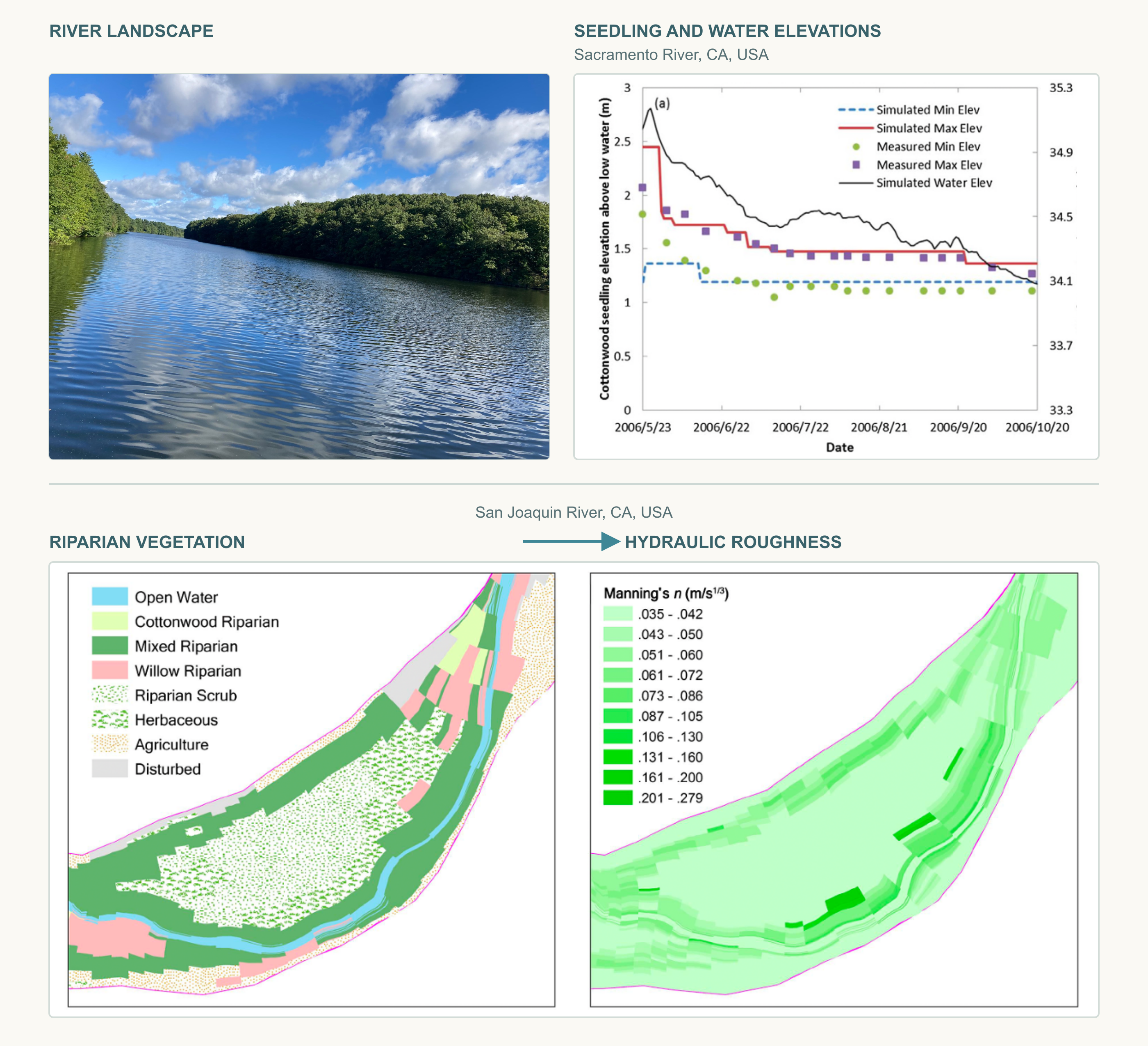
River photograph, Sacramento River seedling and water-elevation graph, and paired San Joaquin River riparian vegetation and hydraulic roughness maps
Click the figure to view its maps and graph at full size.

Flow – Riparian Vegetation Interactions

Riparian vegetation is a critical component of river ecosystems. Its life cycle is closely coupled with river flow regimes. Meanwhile, vegetation alters hydraulic resistance and can substantially influence water levels, particularly during floods.

In collaboration with the U.S. Army Engineer Research and Development Center and the U.S. Bureau of Reclamation, we coupled a riparian vegetation model with the widely used one-dimensional hydraulic model HEC-RAS to:

  • Evaluate the performance of 11 methods for estimating vegetation-induced hydraulic roughness
  • Simulate the two-way interactions between river flow regimes and riparian vegetation dynamics along the Sacramento River.
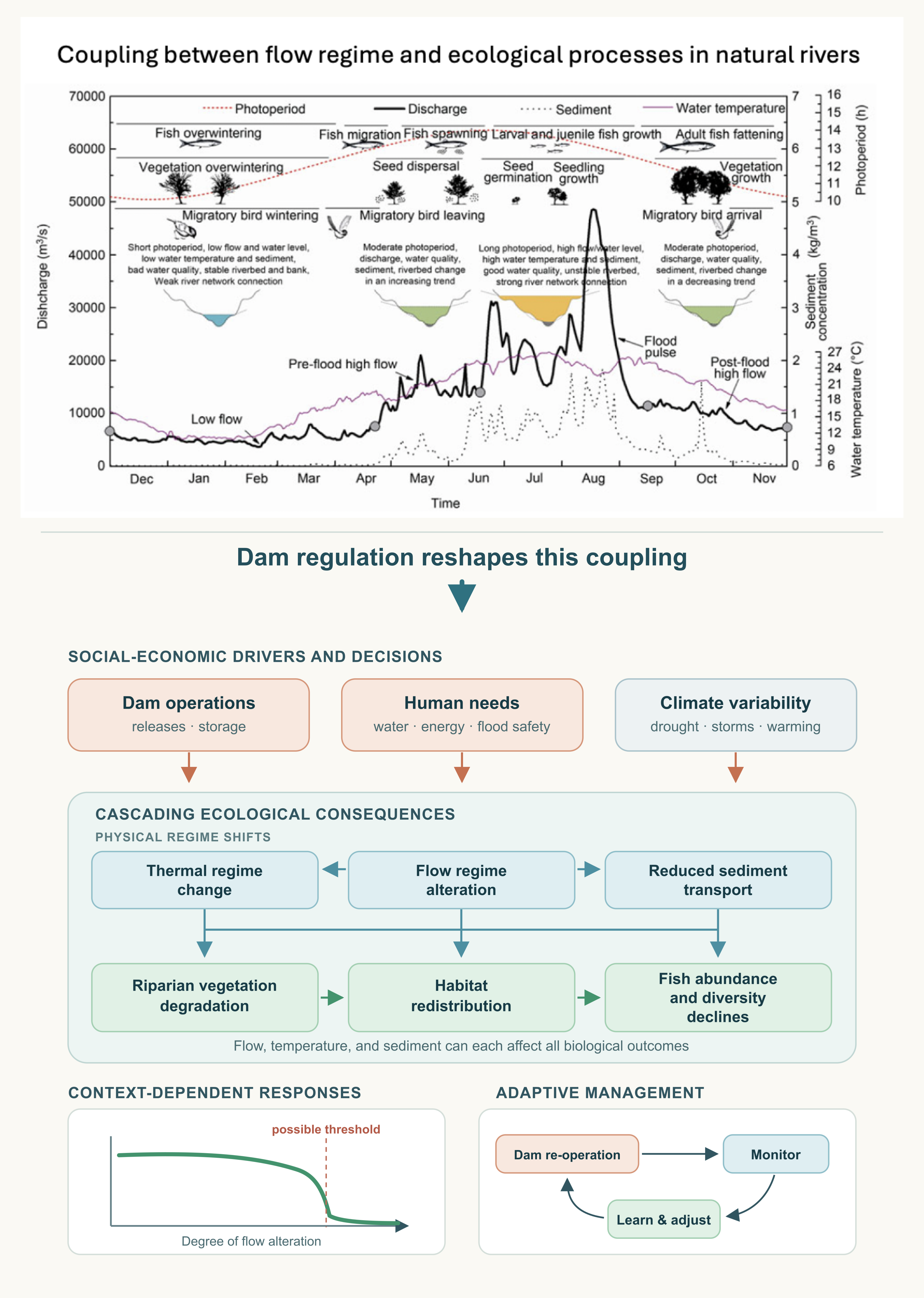
Natural river processes connected by a prominent arrow to cascading ecological consequences, nonlinear responses, and adaptive management in dammed rivers
Click the figure to view both panels at full size.

Dammed Rivers as Complex Social–Ecological Systems

Dams fundamentally reorganize river systems by altering flow, temperature, sediment transport, connectivity, and habitat. These changes propagate through coupled hydrologic, geomorphic, and ecological processes, often producing nonlinear responses, feedbacks, and long-lasting legacy effects.

Working in the Yangtze River downstream of the Three Gorges Dam—one of the world’s largest and most consequential hydropower projects—our research addressed:

  • How did dam regulation reshape river ecosystems, from flow and thermal regimes to fish diversity?
  • How can environmental flows and adaptive management restore key ecological processes and functions in regulated rivers?